Everywhere is War
An Essay on the Endless Cycle of Conquest and Oppression

Good morning, Substack friends!
My most recent Sling Shot Politics story on my time working at the Teamsters headquarters and the union’s abrupt turn to the right under Sean O’Brien generated a lot of strong responses, particularly among labor activists, Teamster members, and other former union staff. The wave of reactions was another reminder of the intensely political and partisan culture of the union, which I explore in the article itself. I will be doing a follow-up piece on the Teamsters in the coming weeks (don't worry — it'll be much shorter).
A forthcoming article on the recent gutting of the Voting Rights Act, against the backdrop of the ongoing U.S.-Israel imperial quagmire in Iran and other unpopular wars, is in progress. That will be followed by an in-depth story looking at Israel's unending genocide in Gaza, its accelerated pogroms against Palestinians in the West Bank, and its use of torture and sexual violence against anyone resisting the colonial ethnostate that is Israel.
In the meantime, the following is another excerpt from my unpublished manuscript.
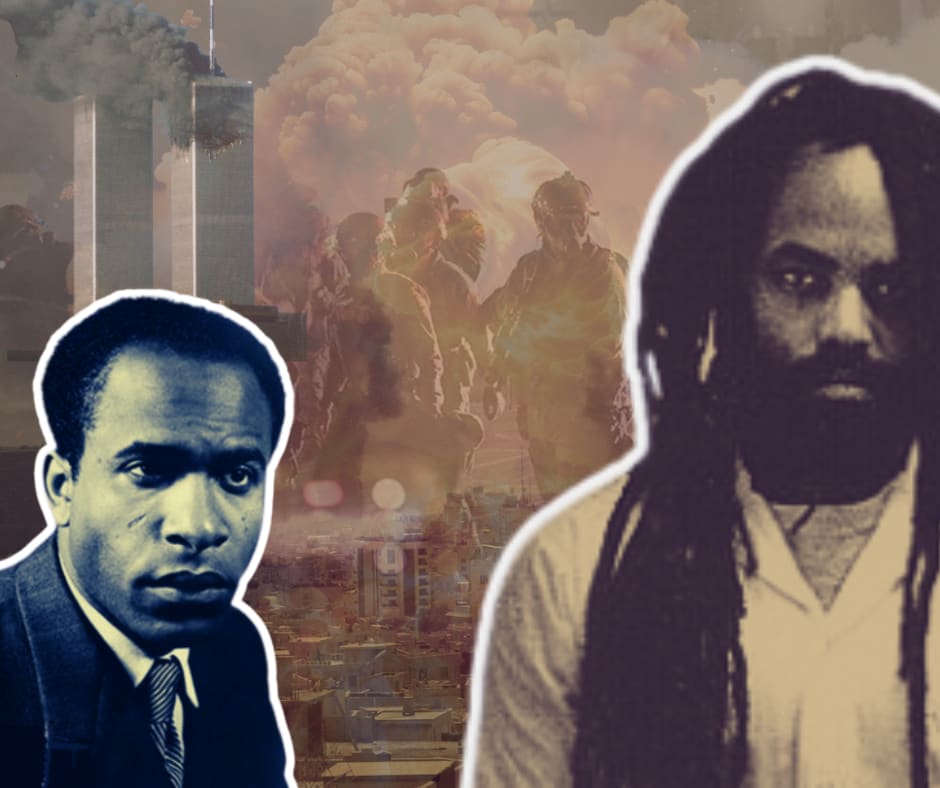
IT WAS A BRIGHT SUNDAY AFTERNOON the day I decided to write a letter addressed to a death row inmate at the State Correctional Institute at Greene in Waynesburg, Pennsylvania. It was a time when a handwritten letter was still considered to be more meaningful than typed correspondence. I had just begun my sophomore year of high school and was growing into a political consciousness very much shaped by the inmate to whom my letter was written. After reading two of his books and countless pieces of literature about his case, I had become deeply familiar and passionate about the innate injustices of America’s criminal “justice” system and its oppressive carceral infrastructure. My nascent politics were developing along a radical trajectory. And on that Sunday, my letter to political prisoner Mumia Abu-Jamal would lead me further into a life of left-wing politics and activism.
Mumia has been incarcerated since 1981, wrongly convicted for the murder of a police officer in Philadelphia following a trial that was rife with injustice, irregularities, and unabashed racism. A journalist and former Black Panther, Mumia had earned his reputation as a voice of the voiceless for Philadelphia’s poor Black communities suffering under the boot of racist law enforcement and routine police brutality. His case is known the world over; streets are named after him in other countries. He is undoubtedly America’s most well-known political prisoner and a prolific writer with many published books written from behind bars. So, I wanted my letter to be perfect. I rewrote the letter twice because I didn’t want to send loose-leaf sheets with scribbled out typos or globs of white-out. I sent the letter the next day, fully expecting that a reply would take many weeks, if it ever came at all — such was the nature of prison mail, so I had read. To my astonishment, I was honored to receive an envelope only a week later, addressed from SCI Greene. Mumia thanked me for my letter and my words about how influential his words has been on my young political mind. He also included a short list of recommended books by other authors which he believed would further my political education. Most of the titles on his list were leftist books on the bloody history of U.S. foreign policy, a topic I knew almost nothing about up to that point. In the ensuing months, as I poured through these works, my radicalization deepened.
It turns out my education in the crimes of American imperialism coincided with a cataclysmic flash point in the history of that imperialism. In the days between me sending my letter to Mumia and his pen-scripted reply delivered in my mailbox, the deadliest terrorist attack in U.S. history rocked the nation and the globe. In fact, rising smoke was still visible on the New York City skyline the following Saturday when I opened Mumia's letter.
With all the privileges of a middle-class white kid growing up in the suburbs, I suspect the world after September 11, 2001 would have looked quite different to me had I not read the books Mumia recommended, including William Blum's Rogue State and John Stockwell's The Praetorian Guard. The long history of U.S. military interventions, covert CIA operations, orchestrated coups, assassination plots, and U.S.-backed dictatorships in the Middle East and across the globe were indispensable context for the events of 9-11. They also catapulted me into the fledging anti-war movement in the lead-up to the Iraq War and into a lifelong commitment to revolutionary socialism, eventually finding me working for many years in the labor movement.
A singular thread runs through this political trajectory: an all-encompassing struggle against oppression and the endless conflicts born out of systems that perpetuate oppression in so many forms.
But where does oppression come from? At its core, oppression is about power. It stems from the oppressor’s desire to preserve and build power at the expense of others, the oppressed. This is fundamental to virtually all human relations in which conflict arises, from the abuses committed by the schoolyard bully to the atrocities committed by one nation against the population of another. It festers in the smallest, most routine instances of social relations, like the hierarchy between a domestic helper and the master of the house who has done nothing in particular to deserve his power over the housekeeper. His power is derived from wealth, which itself is derived from exploitation and inheritance; the stratified roles between him and his housekeeper are accidents of birth, predetermined within a deeply unbalanced, oppressive society. So it is impossible to understand oppression without understanding the balance of power — or, more precisely, the imbalance of power — that sustains any form of oppression.
The tools of oppression are varied but generally take shape as acts of exclusion or violence — or both. On its own, oppressive violence can be physical and economic. Today in the U.S., we see heightened physical and economic violence sanctioned and perpetrated by business and government as right-wing leaders ruthlessly pursue their perennial goal of eliminating every inch of government designed to serve the good of the public while leaving intact only the most destructive and draconian elements of the state, i.e., the infrastructure of the military and the carceral system. To achieve this, the Project 2025 architects made it clear their aim was to make federal workers as miserable as possible while engineering their failure. This is the same script followed by wealthy charter school ideologues who push to divert funding away from public schools only to use the inevitable “failure” or low performance of said schools to justify replacing them with for-profit charter schools. There's nothing innovative under way; it’s merely the same old “Shock Doctrine” politics, albeit on a grander scale.
Without a class analysis — that is, an appraisal of the imbalance of power between classes — and an understanding of how so much oppression is rooted in class, it is impossible to challenge the crises unfolding across the globe and particularly in the United States. The feeble displays of protest by the leaders of the Democratic Party who are fixated on the rule of law are a case in point. After all, laws only matter when they benefit the oppressor. That’s why enforcement of laws against wage theft, which is rampant throughout the U.S. economy, is essentially non-existent. Laws against the crimes of the poor, on the other hand, are ruthlessly enforced and prosecuted.
We also see this in the more recent erosion of international laws, which have increasingly outlived their usefulness to the most oppressive nations. The U.S. demonstrates this every day in its bipartisan support for war crimes in the Middle East. We see today a nation that believes not in international law but in the exertion of military and political power. Any alignment between U.S. foreign policy and international law is incidental to the function of empire, hegemony, and the preservation of its primary satellite regime in Israel. How else does one explain the bipartisan condemnation of the International Criminal Court when it sought arrest warrants against Israeli leaders in 2024? In its stumbling arrogance, the U.S. made it clear that it expects the application of international laws by an international body to be subordinated to the joint political agenda of Washington and the apartheid state of Israel. Much like the domestic laws of the U.S. are written, enforced, and selectively prosecuted against the poor and powerless, the U.S. is only interested in wielding international laws against its enemies. This is why no one should ever take seriously the rhetoric of former President Biden and those associated with his centrist liberal administration as they couch their violent policies in a cynical respect for the rule of law. When they wax virtuously about international norms and conventions, they are merely talking about the preservation of global U.S. dominance and, in the case of Palestine, the expansion of Israel’s settler-colonialist state.
The problem of violence in any political struggle is never a simple moral question about acts of violence in and of themselves. In fact, the only elements of society that can afford to pretend violence is one vast negative monolith are those who enjoy a monopoly on violence by virtue of their power. The liberal elite wing of the ruling class is the primary purveyor of this simplistic notion of violence. You can hear it in their denunciation of violence on “both sides,” their equation of the violence of the oppressor and the violence of the oppressed, as if there is no distinction. Ashamed by their own power and the violence that flows from it, they want us all to see the world while blind to the power dynamics that are at the core of every political movement and conflict. Hence, in the most recent example, the legacy media’s negative depiction of the violence of Israel, armed to the teeth with U.S. weapons, and the violence of Palestinian resistance fighters firing less sophisticated rockets upon Israel and inflicting barely a fraction of casualties as compared to Israel’s mass atrocities.
Of course, this is nothing new. The renowned Marxist political philosopher Frantz Fanon observed this orientation on violence in his study of decolonization movements in Africa in the 1960s:
In the colonies, the foreigner coming from another country imposed his rule by means of guns and machines...The natives’ challenge to the colonial world is not a rational confrontation of points of view...Colonialism is not a thinking machine, nor a body endowed with reasoning faculties. It is violence in its natural state, and it will only yield when confronted with greater violence.
The historical and moral distinction between the violence of the oppressor and that of the oppressed, as observed by Fanon and other thinkers, was central to my young political education. And its relevance to the struggles and conflicts that have erupted over the course of my lifetime has endured. The violence of the oppressor is raw — it is pure unprovoked aggression. Its execution typically compounds the economic violence of the oppressive class, which often precedes physical violence. That economic violence is justified by the oppressive class through some form of supremacist ideology which says this land, or those resources, or these rights belong exclusively to them. Physical violence, in turn, becomes necessary for enforcing economic violence. This framework runs through all systems of colonialism and neocolonialism, from Jim Crow segregation in the U.S. South — using violent force to repress and deprive Black communities of resources and rights — to what we see happening today in Palestine where apartheid policies are violently enforced to deprive Palestinians of land and resources in the name of a supremacist ideology known as Zionism.
The violence of the oppressed, on the other hand, is defensive in nature. It is a reaction to the economic and physical violence initiated by the oppressors. And, of course, this violence — this resistance — is more readily labeled “terrorism” by the oppressor to obscure the fact that the oppressor, owing to his power over others, already set the cycle of violence into motion. In the years following the onset of the Great Recession in the 2010s, a wave of protests that often turned violent erupted across Europe and North America. Workers and students physically took over public spaces, occupying whole universities, and clashing with the forces of the state. Riots and protests were in response to crippling austerity measures being enacted, cutting social programs so that workers and the poor would be forced to pay for the excesses of the elite ruling classes that had brought the global economic order to the brink of collapse. This economic violence sparked popular resistance, including economic violence by the masses in the form of general strikes, which were met with further physical violence from the state at the behest of the ruling elite.
There are countless other examples of this interplay of violence between oppressing classes and oppressed classes, but here it is worth pointing out the role of the state and its everyday mechanism of physical enforcement: the police. The Trotskyist trade unionist Farrell Dobbs explained the role of the police in his writings on historic labor battles in the U.S. in the 1930s:
Under capitalism, the main role of the police is to break strikes and to repress other forms of protest against the policies of the ruling class. Any civic usefulness other forms of police activity may have, like controlling traffic and summoning ambulances, is strictly incidental to the primary repressive function.
This function of the police holds true even in its infant stages where, in the U.S., the first iterations of modern policing were deputized for the sole purpose of hunting down runaway slaves. Then, as now, the police are the chief purveyors of violence not for “the public good” but for the preservation of property relations and those who benefit from them, i.e., the oppressive ruling class that controls most of the wealth and all means of wealth production.
None of this violence born of oppression is evitable, however. We often hear the argument that these cycles of domination, greed, oppression, and violence are simply at the core of human nature. Right-wing libertarianism has convinced many that it boils down to selfishness — selfishness which such libertarians happen to embrace and celebrate — that is written into the genetic code of humanity. This, of course, ignores that tendency toward cooperation and solidarity which stubbornly asserts itself in between and even within violence conflicts. Why? Because all of these attributes, be they greed and oppression or collectivism and mutual aid, are learned values and behaviors. They are either nurtured or left to rot, depending on how we organize society and what political systems we live under. At its core, capitalism brings out the worst in us. It extols greed and selfishness while socialism nurtures empathy, compassion, and community.
Today, we must ask ourselves what kind of society we want to live in. Do we want to live in a society defined by greed, oppression, and violence? Do we want capitalism? Or do we wish to live in a world that runs on cooperation and solidarity — not merely as abstract ideals but as the governing principles around which society is organized and how it functions?
For me, the answer is as clear as it was on that bright Sunday in 2001. It is as real and tangible as the envelope I held in my hands on that day and as urgent as the smoke still rising from the New York City skyline that afternoon.